Showing posts with label Art History. Show all posts

Monday, August 7, 2023

A Lute Spotting (Another Lute Identified?)

Another one of my favorite lute paintings is Peter Paul Rubens' (1577-1640) painting of the lute player wearing the ruff.  Rubens painted this glorious painting, circa 1609-1610 and it is very much in the formal portrait style of so many Dutch paintings of the period.  What stands out is the wonderfully detailed and accurate depiction of the lute being held by the sitter.  The subject serious and confident, and certainly seems to know what he's doing.   This is not a prop found in the corner of the artist's studio!  

This lute seems to be a 10-course on the larger size- perhaps approximately a 70cm string length.  The lute seems to be in the "old" renaissance tuning, given that the left hand fingers are in the nominal Bb major chord position.  This would seem to be the standard tuning in 1609-1610 in the Netherlands, contemporary with Van Der Hove and Vallet's publications of lute music.
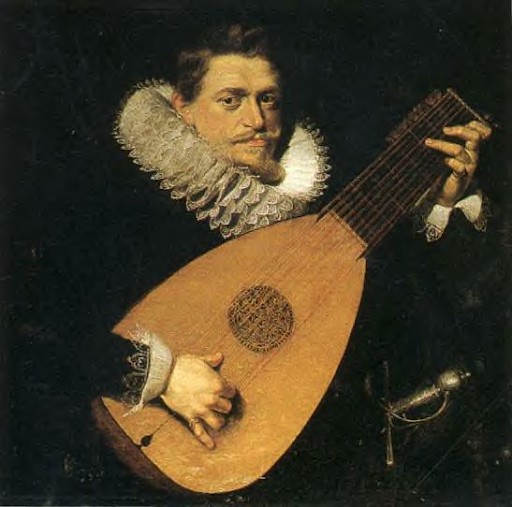
Lute Player (1609-1610) Musée des Beaux Arts in Troyes (1)

This lute in the painting looks to be very similar to the surviving Hans Frei lute in the Warwick County Museum in the UK.  This lute known as the "Warwick Frei", which survives as a 10-course lute, but there is evidence that there was a treble rider that broke off and was never replaced.  The body has been thought to be originally from the early to mid 16th Century, probably originally built as a 6 course lute, and went through subsequent changes as tastes changed as the years went by.


I am not insinuating that the lute in the painting is the exact same as the one in the Warwick museum- the lute in the painting includes an inlaid spade behind the bridge and a different rose.  Also, Rubens was detailed enough to include the crack in the soundboard between the spade inlay and the bridge- common misfortune that lutenists have dealt with for hundreds of years as this painting points out!
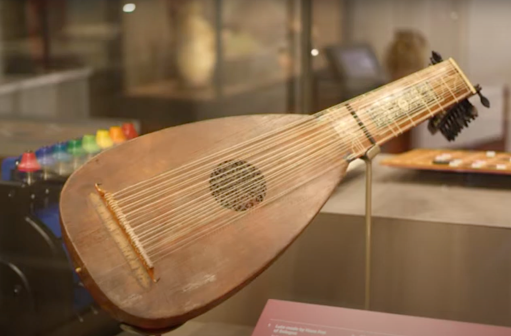


 The Hans Frei lute on display in the Warwick County Museum


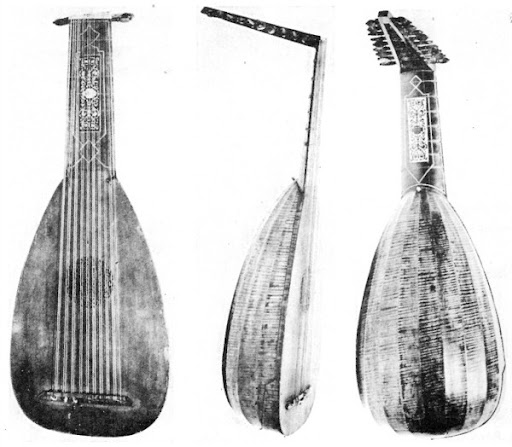
Three views of the lute-


Regarding the "Warwick Frei", something that's interesting to me is that the style and geometry of the body seems to be unique- even Hans Frei's other lutes that survive bear little resemblance to this instrument- The contour of the body and deep end clasp seem to be unlike other lutes.  If you know of other Frei lutes that are similar, feel free to comment.


Here is a recent Eleven Course version that I made recently.  It has a slightly longer string length at 71cm and the added treble rider for the chanterelle.


I'll finish with this interesting side note- Rubens seems to have painted the same man when he was younger in 1597.  No lute though- perhaps he left his seven course lute that he had at the time at home for this painting?  


Portrait of a Man, 1597 Possibly an Architect or Geographer, Metropolitan Museum of Art (Met), New York City, NY, US

(1) (edited 9/16/2023 for location of painting)

Saturday, March 13, 2021

Lute Spotting - A Lute Identified?

One of my favorite paintings featuring a lute is "The Lute Player", by the French painter Valentin de Boulogne working in Rome in the mid-1620's.  I remember seeing this for the first time on the cover of Paul O'Dette's seminal recording from the early 1990's, "Il Tedesco della Tiorba" which contained theorbo and lute solos of Kapsberger.


This wonderfully detailed and dramatic painting is in the same style of several artists of the time.  It is a fine example of "Chiaroscuro" style, which uses bold contrasts of light and dark, with the elements of the painting either highlighted by a single point of light... or hidden in the dark shades of mystery.  

This dramatic aesthetic of light and dark is also reflected in much of the Italian music of the time.  Some examples being Simone Molinaro, Alessandro Piccinini and Giovanni Kapsberger's solo lute and theorbo music (see previously mentioned recording) as well as with Monteverdi's madrigals and early operas. 

The lute in the painting seems to have a the wide body, multi-rib style seen in so many paintings of the period.  In fact, we are fortunate that several instruments of this style still survive in museum collections.  Lute makers such as Harton, Dieffopruchar, Rauwolf, Sellas and Venere of the early seventeenth century all made lutes in this style.

The lute appears to be a seven-course instrument, although I believe there was some debate on social media a few years back of whether there's an eighth course.  Perhaps a "split" seventh course with two single strings at different pitches.  Pragmatic indeed if true!  Alas, we cannot see the back to get an idea of how many ribs or the material.

For more information, the painting is part of the collection at the Met Museum in New York City https://www.metmuseum.org/art/collection/search/439933


I submit for your approval...


One of the surviving lutes with which we might find a connection is the lute by Magno Dieffopruchar, Venice 1612 presently kept in the Museo Civicio in Bologna #1753.  (also a seven course!)  This lute also typifies the wide-bodied roundish lutes of the style built in Venice in the early 17th century.  Although several examples of these style of lutes survive, I think that this particular lute is a perhaps one of the more extreme examples of this style, with a profile that seems to closely match the lute in the above painting.  

                                                                                                                photo by Robert Lundberg


Well, I am not saying they are the exact same lute- indeed, the roses differ and the fingerboard points or "beards" are smaller in the painting.  However, perhaps they could have been from the same workshop and same model.  Hypothetical... but possible.  Maybe.


What do you think?