Showing posts with label Lute Playing. Show all posts

Monday, August 7, 2023

A Lute Spotting (Another Lute Identified?)

Another one of my favorite lute paintings is Peter Paul Rubens' (1577-1640) painting of the lute player wearing the ruff.  Rubens painted this glorious painting, circa 1609-1610 and it is very much in the formal portrait style of so many Dutch paintings of the period.  What stands out is the wonderfully detailed and accurate depiction of the lute being held by the sitter.  The subject serious and confident, and certainly seems to know what he's doing.   This is not a prop found in the corner of the artist's studio!  

This lute seems to be a 10-course on the larger size- perhaps approximately a 70cm string length.  The lute seems to be in the "old" renaissance tuning, given that the left hand fingers are in the nominal Bb major chord position.  This would seem to be the standard tuning in 1609-1610 in the Netherlands, contemporary with Van Der Hove and Vallet's publications of lute music.
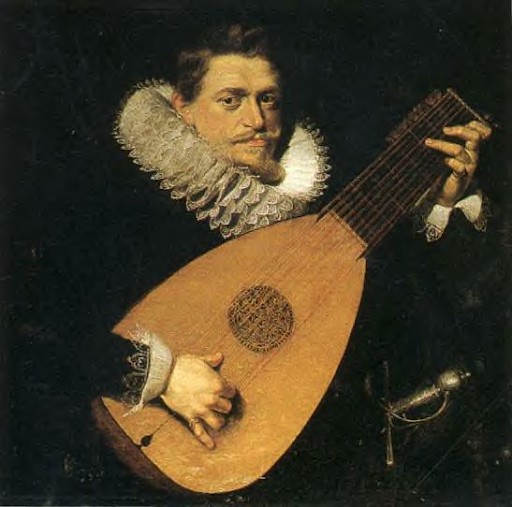
Lute Player (1609-1610) Musée des Beaux Arts in Troyes (1)

This lute in the painting looks to be very similar to the surviving Hans Frei lute in the Warwick County Museum in the UK.  This lute known as the "Warwick Frei", which survives as a 10-course lute, but there is evidence that there was a treble rider that broke off and was never replaced.  The body has been thought to be originally from the early to mid 16th Century, probably originally built as a 6 course lute, and went through subsequent changes as tastes changed as the years went by.


I am not insinuating that the lute in the painting is the exact same as the one in the Warwick museum- the lute in the painting includes an inlaid spade behind the bridge and a different rose.  Also, Rubens was detailed enough to include the crack in the soundboard between the spade inlay and the bridge- common misfortune that lutenists have dealt with for hundreds of years as this painting points out!
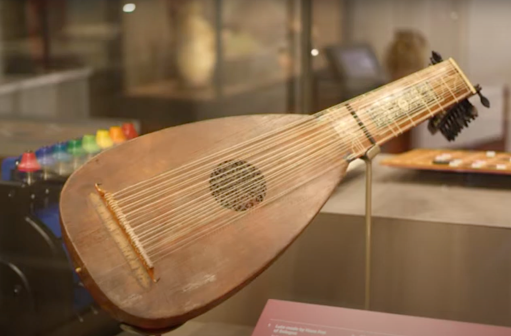


 The Hans Frei lute on display in the Warwick County Museum


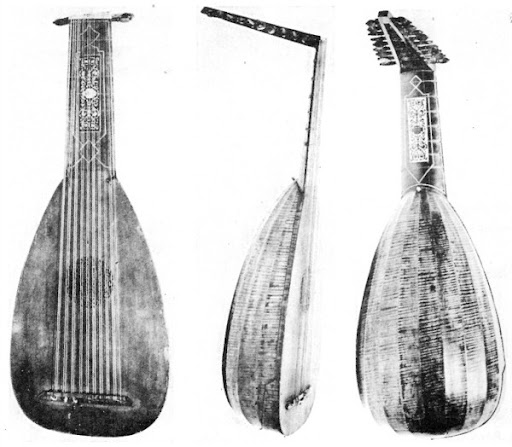
Three views of the lute-


Regarding the "Warwick Frei", something that's interesting to me is that the style and geometry of the body seems to be unique- even Hans Frei's other lutes that survive bear little resemblance to this instrument- The contour of the body and deep end clasp seem to be unlike other lutes.  If you know of other Frei lutes that are similar, feel free to comment.


Here is a recent Eleven Course version that I made recently.  It has a slightly longer string length at 71cm and the added treble rider for the chanterelle.


I'll finish with this interesting side note- Rubens seems to have painted the same man when he was younger in 1597.  No lute though- perhaps he left his seven course lute that he had at the time at home for this painting?  


Portrait of a Man, 1597 Possibly an Architect or Geographer, Metropolitan Museum of Art (Met), New York City, NY, US

(1) (edited 9/16/2023 for location of painting)

Sunday, August 6, 2023

The audience doesn't give you extra credit for reading from a facsimile.


"Yeah... but I would have enjoyed the concert so much more if they were reading from facsimile."

Said no one...  Ever.  

I jest-fully point this out because in the world of early music, whether it be performance or lutherie, we can adopt a dogmatic attitude that only  X   is acceptable and that somehow any other way is fakery, not legit or amateurish.  However, I would argue that it is the end result that matters.

So get out on stage and do what you gotta do.  Ready... go!

But sometimes, you gotta do what you gotta do to get through the gig- not cheating mind you, but you figure out ways to make the process of music making smoother, from page to eye to brain to fingers, in order to deliver a better performance. 


OK, I will admit that I've written in chords symbols in jazz-style shorthand for a Bach cantata that I had to learn in a few days with one short rehearsal.  It helped me filter through the gazillion 16th notes on the page which were being played by the cellos around me.  The fact is, the audience was none the wiser and could be captivated by the sound of my theorbo and my stress-free demeanor.


But what about historical accuracy?


Let's face it, if we would be slavish about complete historical accuracy, then performers should only perform in period costume and abstain from bathing for several months- just to make the performance that much more convincing.  Everyone up to about the fifth row will be aware of you total dedication and commitment.


Le pew!


OK, so what about lute making?

As I've discussed before, modern lute-making presents modern builders with challenges.  Staying true to the art of lute making, as we live in a modern age, requires making various "compromises".  We have things they didn't have, such as electric light, electric tools like bandsaws, bending irons and glue pots.  Beside all that, other useful items the masters didn't have.  

"What is this sandpaper you speak of?"

The truth is, today's audience and modern lute players have an expectation of aesthetic perfection- far beyond what the old guys were familiar with.  But the market demands it... 

Today's luthiers be like:

"I don't use sandpaper...  Except when I do"


Cheers!

Tuesday, March 14, 2023

A New Website

It has been a while since I have posted here but I have been busy, busy busy as of late.  The last year has been busy with a workshop move, etc.   However, I am happy to announce that I have finally launched my new website: 


https://www.goodlutes.com/


Please feel free to visit, say "Hi" via the Contact form and let me know if you see any typos!  


Cheers!

Friday, October 29, 2021

Finding your way- Monkeys, Typewriters and the complete works of Shakespeare


If you haven't already heard it, there's a saying, "If you put a bunch of monkeys in a room with a typewriter, they will eventually write the complete works of Shakespeare."


This phenomenon has actually got a name- it's called the Infinite Monkey Theorem

https://en.wikipedia.org/wiki/Infinite_monkey_theorem


I know what you're thinking, here we go again with the obtuse references.  Land the plane, Bill... what does this have to do with luthierie?


Sometimes, as an instrument maker working alone, you feel like you're finding your way along, but your journey is beset with obstacles, mistakes, do overs.  What this ultimately means is (hopefully) improvement.  You learn what works but many times by learning what NOT to do.  The important thing is the end product that leaves the shop is up to snuff and everyone is happy.


But, for me there's always that nagging feeling that there's improvement to be had somewhere.  It could just be in the process and how it can be improved.  I'm not doing mass-production but if there's a more efficient way to do something, I'm open to it. 


Compared to guitar and violin makers, lute makers are a very rare breed,- schools are rare as are other in-person methods of learning.  Aside from the ultra-rare apprenticeship, it's impossible to completely circumvent the process of trial and error, especially when starting out.  A period discovery ensues where one finds that what seems to work for some, may not work for others.   For instance, I think of one maker's method of fitting ribs to build the back of a lute- which is completely different to other makers' methods- which is different than the method I have become comfortable with.


As stated before, I am very grateful to those who have been so helpful to give me advice.  I will say that however helpful in unlocking the secrets of lute making, all the advice in the world can't give you the tactile experience of what doing fine work feels like with your hands.  For example, I've asked myself-

How much pressure to use with that chisel?

What does the consistency of the hide glue need to feel like for that given operation?

How much should I thin that varnish?


DoyaknowwhatImean??? 


Not yet... I'm still typing.


Saturday, March 13, 2021

Lute Spotting - A Lute Identified?

One of my favorite paintings featuring a lute is "The Lute Player", by the French painter Valentin de Boulogne working in Rome in the mid-1620's.  I remember seeing this for the first time on the cover of Paul O'Dette's seminal recording from the early 1990's, "Il Tedesco della Tiorba" which contained theorbo and lute solos of Kapsberger.


This wonderfully detailed and dramatic painting is in the same style of several artists of the time.  It is a fine example of "Chiaroscuro" style, which uses bold contrasts of light and dark, with the elements of the painting either highlighted by a single point of light... or hidden in the dark shades of mystery.  

This dramatic aesthetic of light and dark is also reflected in much of the Italian music of the time.  Some examples being Simone Molinaro, Alessandro Piccinini and Giovanni Kapsberger's solo lute and theorbo music (see previously mentioned recording) as well as with Monteverdi's madrigals and early operas. 

The lute in the painting seems to have a the wide body, multi-rib style seen in so many paintings of the period.  In fact, we are fortunate that several instruments of this style still survive in museum collections.  Lute makers such as Harton, Dieffopruchar, Rauwolf, Sellas and Venere of the early seventeenth century all made lutes in this style.

The lute appears to be a seven-course instrument, although I believe there was some debate on social media a few years back of whether there's an eighth course.  Perhaps a "split" seventh course with two single strings at different pitches.  Pragmatic indeed if true!  Alas, we cannot see the back to get an idea of how many ribs or the material.

For more information, the painting is part of the collection at the Met Museum in New York City https://www.metmuseum.org/art/collection/search/439933


I submit for your approval...


One of the surviving lutes with which we might find a connection is the lute by Magno Dieffopruchar, Venice 1612 presently kept in the Museo Civicio in Bologna #1753.  (also a seven course!)  This lute also typifies the wide-bodied roundish lutes of the style built in Venice in the early 17th century.  Although several examples of these style of lutes survive, I think that this particular lute is a perhaps one of the more extreme examples of this style, with a profile that seems to closely match the lute in the above painting.  

                                                                                                                photo by Robert Lundberg


Well, I am not saying they are the exact same lute- indeed, the roses differ and the fingerboard points or "beards" are smaller in the painting.  However, perhaps they could have been from the same workshop and same model.  Hypothetical... but possible.  Maybe.


What do you think?

Monday, January 11, 2021

What Would Dieffopruchar Do?

For the namesake entry to this blog, I'd like to ponder;  If the old masters were around today, how would they build a lute?


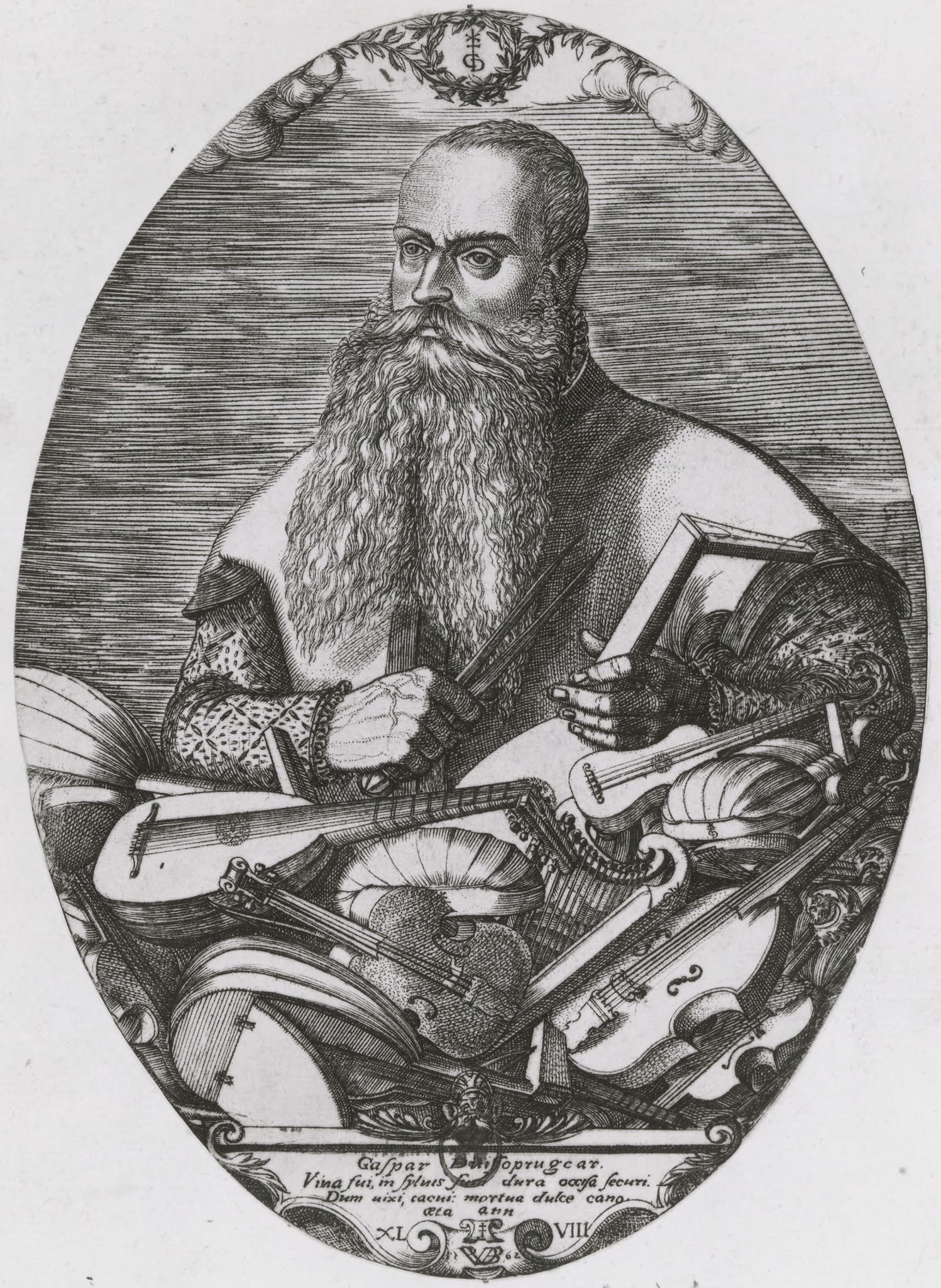
The man, the myth, the legend… the beard


OK, first we have to clarify- exactly WHICH Dieffopruchar are we talking about???  The “D” family (or “T” if you want to include the Tiefenbrucker spelling in the dozen or more variants)


Tieffenbrucker, Tiefenbrugger, Tiefenbrucker, Teufenbrugger, Tuiffenbrugger, Deuffenbrugger, Dieffopruchar, Dieffoprughar, Duyfautbrocard, Duiffopruggar, Duiffoprugcar, Dubrocard, Dieffoprukhar, Diafurgopruchar, Thabiphobrucar


All that and a bag of chips.  Can we include these as well?


Sorry, I got distracted.  Anyway, the Dieffopruchar’s had a dynasty that lasted generations, and they made the early classic 6-course lutes to baroque beasties.  So, “What would Dieffopruchar do” might make a nice moniker for a bracelet, t-shirt or a bumper sticker but we can include all of the masters of that age- Maler, Rauwolf, Unverdorben, Railich, Buchenberg, Tesler, etc. 


OK, so what would they do?


To the question, I am wondering what their operations would look like if they were to produce lutes and the like today.  To paraphrase 20th-century master lute maker Stephen Gottlieb, unless you use the traditional materials you end up with something that’s not really a lute.


Following the parameters and recipe to make something that resembles a lute- looks like a lute, plays like a lute, and sounds like a lute… how much leeway do we have?  Good old “Grandpa D” didn’t live in the mass-production age that we do, but his shop turned out thousands of lutes in an efficient way.  Demand was high enough that everyone wanted one and had to get one.


The reason I bring this up at all is that today, as those relative few who are trying to study drawings, stay within the tolerances, tapping on soundboards… when “Gaspar D” or one of his factory workers tapped on a finished soundboard with bars and bridge in place… what did HE hear?  The same thing as us.  

Uh, maybe…  

The other thing is, looking at historical lutes, I am struck at how (from a purely aesthetic point of view), the old masters' work might be looked at today with our eyes that are accustomed to mass produced goods.  Even the cheapest guitar today has a level of perfection the old renaissance masters wouldn’t dream of… even if that modern guitar sounds like a shoe box with strings.  For us modern folk, we hear with our eyes.

OK, I realize that I’m kind of chasing my tail here with unanswerable questions and hypotheticals.  

In application, as a modern maker, every time I reach for _______ (fill in the blank with a modern substance) am I violating some sort of unwritten early music / Historically Informed code of ethics?   Should I be concerned that somehow it might imperceptibly influence the audience’s enjoyment in hearing a performance on the instrument in question?  How dogmatic do we get?  

For instance, some modern makers have sworn off modern inventions such as sandpaper and shellac altogether.  Interesting to note that in Lundberg’s book he doesn’t use sandpaper but then finishes the renaissance lute in a 19th Century French Polish.  From a practical point of view, the results are beautiful, and that type of finish can be applied in a fraction of the time of an oil varnish.  So, how do we balance historical authenticity and modern pragmatism.

My feeling is that good old Dieffopruchar today would use whatever he deemed appropriate and efficient while maintaining the end result of a lute that looks like a lute, plays like a lute and sounds like a lute.  So, would Gasparo have used modern glues, finishes, strings?  

Uh, maybe…

From a musical perspective, it’s like asking what did Dowland sound like?  Or what exactly were Francesco Da Milano’s "silver finger tips"? 

Sorry to stir the pot so vigorously.  When thinking about this, it seems a relatively small matter to simply perform early music in an appropriate way that is accepted in these times.  (It's not!)  The additional complexity comes when creating the objects that will be the vehicles for such a performance.


Tuesday, January 5, 2021

The Journey from Lute Player to Lute Maker

From Lute Player to Lute Maker...


My own background comes from working in my teens as a draftsman, designing and creating crude musical objects since my childhood.  Starting off as a drummer and guitarist, I was transfixed by the sound of classical guitar which led to the lute many years ago.  


As a player of the lute, theorbo and baroque guitar, I have been afforded playing opportunities with many excellent musicians and ensembles.  Several years ago, in a rush of creative energy and dearth of immediate gigs, I made myself a crude medieval instrument, which led to another instrument, which led to another…  I seemed to have a nascent aptitude for it but more significantly, I had been bitten by the bug.   


Imposter Syndrome


Coming at it relatively late in life, (I started building in my 40's) there is a bit of feeling “impostor syndrome”.  After all, I didn't go to school for this or even apprentice with anyone, so I'll never be "legit".  Also, having played the lute and played/owned some really fine instruments, I could never build as well as they do.  All this said, I enjoy working with my hands, it’s indescribable feeling to hear the instrument that you created in the hands of a musician making beautiful music with it.  I learn something new every day (even if it's what NOT to do)


One thing is certain- that this would never have happened if it weren’t for those who have generously and patiently given advice, given feedback and responded to questions and emails.  I am truly thankful!


I encourage other lute players to try their hand at making a lute.  David Van Edwards offers two CD-ROM’s: “Build A Your Own Renaissance Lute” and “Build Your Own Baroque Lute”.  These offer excellent, step-by-step instructions for almost anyone to build these complex machines.  

https://www.vanedwards.co.uk/renlute.htm
https://www.vanedwards.co.uk/course.htm

The late Robert Lundberg published a series of articles for the Guild of American Luthiers in the 1980’s that was posthumously compiled into the book, Historical Lute Construction which I would highly recommend.

https://luth.org/books/historical-lute-construction/


It should come as no surprise that experienced players have valuable insight on what works and what doesn't when it comes to action, set up, string spacing and sound.  You can literally build yourself a custom instrument exactly the way you way it.  But when it comes to building instruments for others, it's important to have some objectivity.  A well-known lute maker asked me early into my building endeavors, "can you divorce yourself from your own preferences?"  

Understandably, players can be understandably skittish when it comes to using sharp tools but with proper training and caution the dangers can be minimized.  I encourage you to give it a try!

Tuesday, December 29, 2020

Welcome!

 Greetings Lute Aficionados!


Welcome to my new blog.  I'm not sure there's much I can add to the discourse on the subjects of lutes, early guitars and lute building these days but there have been a few thoughts bouncing around my brain over the last couple of years that might be worthy of sharing.  Perhaps starting this is a way of prompting me to flesh out these ideas and document them.  


To be sure, there are more talented, better trained and more knowledgable in the arts of lutes and lutherie than myself but perhaps some might find this content interesting, maybe even entertaining.  


Modern day lute players have been in good hands with contemporary makers building very fine instruments for them to play.  As more of that generation of artisan luthiers who researched, documented and built the first Historically Informed instruments are reaching retirement as opposed to reaching for a chisel, I feel it is important that whenever possible, knowledge and expertise needs to be shared.  My experience is meager but perhaps this blog would encourage other more experienced makers to share their secrets.  


Some of my posts will be centered around what I'm working on in my shop- some problem that needs to be solved, a way of doing things that could be done better or more efficiently...  I welcome a dialog in the comments or if you might any have questions.  


More soon...